
ABOUT US

The teachers
-
Mariantonia Riezu is a renowned Spanish historical horn player based in Spain and The Netherlands. She began playing bagpipes aged four, which is heard in her expressivity and musical understanding. Since 2015 she has been playing with the leading orchestras in Europe, Russia and USA. After 8 years, as a member of The Orchestra of Eighteenth Century, in 2024 she has moved on to pursue new synergies and projects aligned with her career as a high-horn player, chamber music artist and soloist. She can be heard regularly playing solo horn concertos with orchestras such as Vigo430 and in halls as “Het Concertgebow Kleine Zaal”. She specializes in solo natural horn music such as her music and poetry project “SOLAS”, awarded by Fonds Podium Kunsten in 2021. Passionate about knowledge she has since 2021 been the Historical Horns bachelor teacher at Conservatorio Música Castellón (SP) where she has built a natural horn specialists class. She is involved in research of didactical repertoire of the 19th century for Spanish and French music.
I am extremely excited to get to know all the enthusiastic natural horn players from Swizerland. I am aware that this instrument is rooted in the Swiss cultural heritage, and there could not be a better environment to explore it than the one created at Beatenberg. I can´t wait to work with all of you there and let the horns be free and wild for few days while sharing our passion for the instrument and it´s rich and unique repertoire.
-
Alexandre Zanetta comes from near Paris and discovered his passion for the horn at an early age. After studying in Berlin and Lübeck, he deepened his knowledge of historical horns at the Schola Cantorum Basiliensis with Thomas Müller and Jean-François Madeuf.
He specializes in the baroque horn with a historically authentic approach. Since 2021, he has been teaching historical horn in Trossingen, at the HEM Geneva, and also at music schools.
As a sought-after musician, he plays with renowned ensembles such as La Cetra, Collegium 1704, and Café Zimmermann. In fall 2022, he succeeded Thomas Müller as professor of historical horn at the Schola Cantorum Basiliensis.


- After completing a bachelor’s degree in piano and a diploma in pedagogy in France, Camille de Nantes continued her studies at the Schola Cantorum in Basel in Edoardo Torbianelli’s fortepiano class. There she obtained a Bachelor’s and a Master’s degree and specialized in accompanying singers in particular.
As a prizewinner of the Fondation Royaumont and the Young Europe Sings Academy, she has had the opportunity to perform in France, Germany, Poland and Slovenia.
Guest and hunting horn specialist:
Wilhelm Bruns’ musical career began as a member of various hunting horn ensembles in Greven, Saerbeck, and Münster. The parforce horn he played during this time laid the foundation for his later passion for the French horn, and especially for the natural horn. While studying with Professor Hermann Baumann at the Folkwang University of the Arts in Essen, he devoted himself intensively to the natural horn from the very beginning, alongside the valve horn. In 1987, he won second prize at the natural horn competition in Bad Harzburg. Since then, he has performed regularly as a soloist and chamber musician with various orchestras and ensembles, including Concentus Musicus Wien, Cappella Coloniensis, La Stagione Frankfurt, Amsterdam Baroque, the Akademie für Alte Musik Berlin, the Neue Düsseldorfer Hofmusik, Rebel (New York), and the Württemberg Chamber Orchestra, among others.
In 1985, he founded the “Deutsches Naturhorn Solisten” together with a group of students who were passionate about the natural horn. This ensemble, which has received considerable acclaim from international critics and remains unrivaled, has been recording CDs for the MDG label in Detmold since 1996. Its focus is on trio and quartet music for the natural horn, as well as hunting music. The CD featuring horn concertos by Georg Philipp Telemann was awarded the Echo Klassik by the German Phono Academy in October 2002. From 1988 to 2021, he served as principal horn at the National Theater in Mannheim and, in October 2000, accepted a position as a lecturer at the music conservatories in Frankfurt am Main, Mannheim, and Saarbrücken. From 2003 to 2018, he directed the International Natural Horn Academy in Bad Dürkheim, which he founded.
In January 2006, a multi-award-winning recording of Wolfgang Amadeus Mozart’s horn concertos was released, featuring the Heidelberg Symphony Orchestra under the baton of Thomas Fey. This was followed in 2010 by another CD featuring Joseph Haydn’s horn concertos.
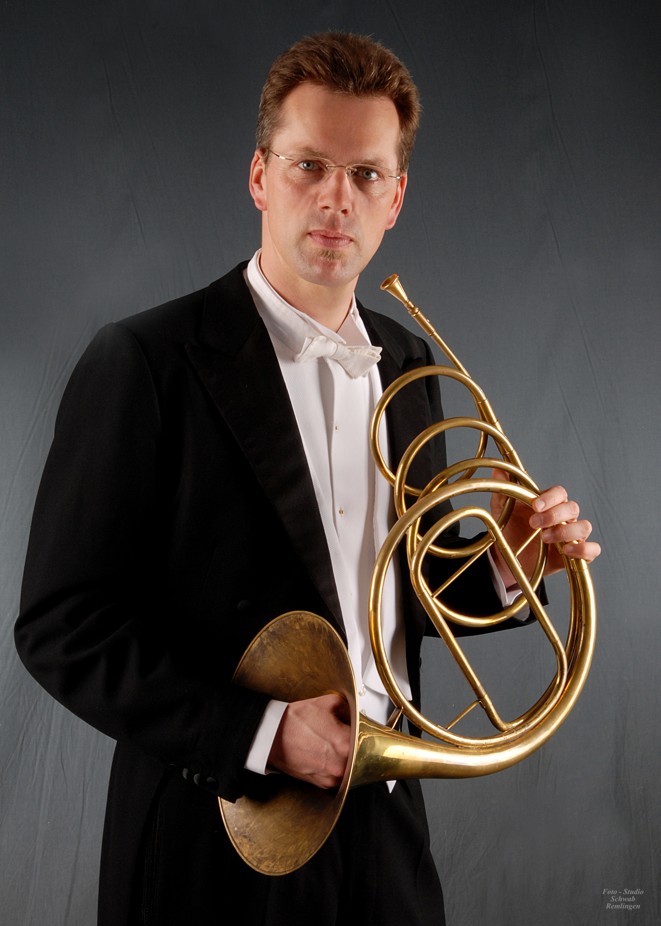
Comments from an amateur natural horn player
Curiosity led me to start playing the natural horn four years ago. I was driven by questions. For example, why do you have to transpose most pieces in a symphony orchestra and not the other instruments? Special brain acrobatics for the horns, which are otherwise already busy enough with their “gills”? Or after listening to various Mozart horn solo recordings, I wondered why some recordings sound a bit monotonous and others are fun, light and with different fascinating timbres as if played by a different instrument? My research led me to the nearby instrument maker Egger, where the story began…
In my search for like-minded people I quickly reached my limits. There are hardly any amateurs in this field. I want to change that which is why I am involved in the organization of the Swiss Natural Horn Academy in Beatenberg and – of course – also take part in them.
There is currently no comparable offer in Switzerland. However, historical performance practice is practiced in the professional scene and will gain importance in the amateur scene with a time lag.
Prejudices against natural horns are particularly widespread among amateurs. They are said to be more difficult to play than modern double horns and the intonation is not right. However, when they are used for the music for which they were created, it quickly becomes apparent that they are perfectly suited to it! There is a lot to be said for the natural horn:
- No more tedious transposing.
- Due to the narrower scale length, the high notes are easier to reach.
- Every crook offers new timbres.
- It weighs much less.
- More virtuoso playing because no valves have to be folded down.
- Interesting new experiences of how the horn sound is formed.
- The longer tubes promote concentrated and clear airflow not only for the natural horn, but also for the modern double horn. The overall sound becomes airier and fuller.
- Stopping is fun!
- Promotes musical imagination, because you have to visualize each note before it is formed.
- The radiant sound of natural tones!
That is why I would like to encourage you all to experience the natural horns together. See you in Beatenberg!
Rahel Schaub


